
Trump’s war with Canada
Clip: 8/28/2026 | 17m 4sVideo has Closed Captions
Trump’s war with Canada
In 1999, the creators of South Park were nominated for an Academy Award for their song, “Blame Canada.” South Park, of course, is caustic and anarchic satire. But today, somehow, it’s become real.
Problems playing video? | Closed Captioning Feedback
Problems playing video? | Closed Captioning Feedback
Major funding for “Washington Week with The Atlantic” is provided by Consumer Cellular, Otsuka, Kaiser Permanente, the Yuen Foundation, and the Corporation for Public Broadcasting.
Trump’s war with Canada
Clip: 8/28/2026 | 17m 4sVideo has Closed Captions
In 1999, the creators of South Park were nominated for an Academy Award for their song, “Blame Canada.” South Park, of course, is caustic and anarchic satire. But today, somehow, it’s become real.
Problems playing video? | Closed Captioning Feedback
Where to Watch Washington Week with The Atlantic
Washington Week with The Atlantic is available to stream on pbs.org and the PBS app.
Buy Now

10 big stories Washington Week covered
Washington Week came on the air February 23, 1967. In the 50 years that followed, we covered a lot of history-making events. Read up on 10 of the biggest stories Washington Week covered in its first 50 years.Providing Support for PBS.org
Learn Moreabout PBS online sponsorshipJeffrey Goldberg: Good evening, and welcome to Washington Week.
Yesterday on Truth Social, President Trump posted a ranking of American presidents.
In the category of the greatest, there's only one entry, him.
The next category, great, includes George Washington, Thomas Jefferson, and Abraham Lincoln.
Bill Clinton and James Madison, among others, are labeled average.
Failures, not surprisingly, include Jimmy Carter, Barack Obama, and Joe Biden.
My question is, why does this behavior not shock or surprise?
On the one hand, Trump is just trolling, and we live in the age of trolling.
On the other hand, it is truly remarkable to see the leader of the most powerful nation on Earth behave like this.
I can understand why many people choose to ignore these behaviors.
After all, insulting George Washington and Abraham Lincoln isn't the same thing as, say, starting wars in the Middle East with no plan to win, but it's all of a piece.
The way Donald Trump talks about American allies is the way he talks about so many Americans.
Joining me tonight to analyze this most unusual situation, Stephen Hayes, the editor and CEO of The Dispatch, Idrees Kahloon is a staff writer at The Atlantic, Josh Wingrove is a White House reporter with Bloomberg News, and Ashley Parker is a staff writer at The Atlantic.
Thank you all for joining me.
I want to get to the specifics of the trade war with Canada in a minute, but, Steve, maybe you can give us a larger framework here.
Why does Donald Trump see Canada as an enemy?
And by the way, if you had said that 15 years ago, why does President Donald Trump see Canada as an enemy, you'd be committed.
Stephen Hayes, Editor, The Dispatch: Well, I mean, I think there are substantive reasons, and there are political reasons.
If you think on the substantive side, we've seen a long series of aggressive provocations by our neighbors to the north, and, no, I'm just kidding.
There's no -- there are no substantive reasons.
Look, I think it's personal.
Jeffrey Goldberg: The price of maple syrup is what you're getting at?
Stephen Hayes: The price of maple syrup, hockey sticks.
Jeffrey Goldberg: Yes.
Stephen Hayes: No, I think it's personal pique.
He hasn't liked their leaders.
I think he sees them as a punching bag.
He doesn't like it when they stand up and defy him.
He expects them to just capitulate.
And when they don't, that makes him angrier and angrier.
But it is strange, you know, when you think about the way that he talks about Canada, and the things that he's done, the policies he's sought to implement with regard to Canada, it is strange because they would make sense if there was this vast population in the United States, political constituent in the United States, that hated Canada, right, that would really benefit him if he were doing all of these things, and there just isn't, you know, to the extent that either people don't care or they love Canada and think of Canada as a friendly, nice neighbor.
Jeffrey Goldberg: Or they just go to Canada because it's a place that you go to visit -- Stephen Hayes: You go to visit, and we have generally good trade relations with Canada and have for years.
So, it's a bit of a head-scratcher to me, honestly.
Jeffrey Goldberg: Yes.
Well, I want to come back to that question about the psycho-anthropological motivations, but, Josh, you're Canadian.
Josh Wingrove, White House Reporter, Bloomberg News: Yes.
Jeffrey Goldberg: And I don't say that as an accusation.
I just say that because it's true.
Explain the situation that the prime minister, Mark Carney, finds himself in right now.
Josh Wingrove: There's a saying in Canada dating back to Pierre Trudeau that living next to the States is like sleeping with an elephant, where every twitch kind of comes at you, and this is really the biggest case we've seen of that.
Canadian public opinion is very clear right now.
Canadians are outraged at the way the president is treating them.
They're outraged not only by the tariff threats, but more broadly by the threats of 51st statehood or, you know, vassalization to some extent.
And so that is the landscape on it.
Arguably, Donald Trump gets a lot of credit for Mark Carney being prime minister.
I mean, the threats that Trump was making really shifted the political landscape in the most recent election where Carney sort of pulled the Liberal Party from the ashes and won his mandate.
And so Carney is on strong political footing, and there's a lot of appetite in Canada for him not to cave.
That brings us to last -- you know, the collapse of this deal last week.
On Tuesday, terms of it sort of came out, and, you know, it was mixed, I would say.
In Canada, there is a belief that they should have the best deal out there, and to some extent they do, and that's -- you wouldn't necessarily know that with the way they're reacting.
For instance, Canada has the lowest effective tariff rate of U.S.
tariffs in the G7.
But the deal as it was coming out drew criticism from provincial premiers in particular, who Carney not only needed political support from, but needed them to do things, including rescind bans on U.S.
alcohol sales or stocking on shelves there.
And so the landscape became a little mixed, and then there were some last-minute flashpoints which we can discuss.
But Carney had a lot of backing, let's say, to walk away if it was a bad deal.
And I think we're in a war of words phase right now.
We still don't really know a lot of what -- Jeffrey Goldberg: Does he want an off-ramp, or is he's in it to win it?
Josh Wingrove: I think he wants a deal.
Sources have always described Carney as someone who's not particularly, you know, guided by a political incentive.
But certainly a fight with Donald Trump, you know, helps him in to some extent and for now.
We've seen, you know, every time Trump attacks Canada, Carney's poll numbers tick up a little bit.
Now, how quickly they'll go back to the table, I think, is unclear.
We're right now in this spiraling case, right?
Trump has imposed new tariffs, 50 percent tariffs on about 20 billion in goods.
Canada has threatened to respond in a smaller way to the same $20 billion, but with a smaller tariff rate.
And so Carney is deescalating a little bit, trying to, you know, bring the temperature down a little bit, as are some of the premiers that made larger statements, including one who invited the president to kiss him on the backside, shall we say.
So, I think the Canadians are doing what Canadians probably normally do, which is, you know, try to dial it down a little bit and keep it between the lines.
Jeffrey Goldberg: But the Canadian population, unlike the American population, which either doesn't care or doesn't really know, the Canadian people, it goes deeper than trade now, the insulting quality -- Josh Wingrove: Provinces that have not banned alcohol have seen precipitous drops in U.S.
alcohol sales.
Canadian travel to the U.S.
is dropping at sharp rates.
Canada is a small country compared to the US, small economy compared to the U.S.
It's also the biggest buyer of U.S.
goods.
Canada buys about twice as much from the U.S.
as China does, for example.
And so when Canada imposes counter-tariffs, they do have an effect because they buy so much from the U.S.
It's the number one customer of U.S.
goods.
Jeffrey Goldberg: Well, Idrees, that's what I want to ask you, the trade war that Trump has gotten, you know, U.S.
into, could it wind up hurting the United States?
Idrees Kahloon, Staff Writer, The Atlantic: A bit.
You know, 14 percent of American exports go to Canada.
That's not nothing.
But it'll hurt the Canadians more if this escalates because 70 percent of Canadian exports go to America.
Carney's aware of that.
I think that's why Carney does want -- you know, the tariffs are going to come in next week.
You know, there's this deadline of enhanced tariffs that would come in, in January.
But I think that everyone is going to work towards a deal.
I don't think they've stopped talking, and I don't think that they're really going to going to let this kind of escalate even further because Carney's very aware of what the risks are.
And even now you've seen hits on GDP unemployment in a way that Trump's trade war on everyone has really not slowed down the American economy.
Jeffrey Goldberg: What are the chances that it does spiral out of control?
Idrees Kahloon: I mean, maybe Josh has -- Josh Wingrove: I think they're a little higher than you might, you know, argue.
We'll see.
We just -- it's too early to say.
Jeffrey Goldberg: Look, we're having a fight over Canadian trade policy.
Josh Wingrove: No, it's -- Jeffrey Goldberg: That's what constitutes a fight.
Yes.
Josh Wingrove: It's too early to say.
The January 1st tariffs the president has announced, he's also threatened to retaliate if Carney proceeds with those tariffs.
And, again, he's deescalated them, like I said.
He also tweaked them a day after announcing them to pull back on fisheries tariffs that you might have accused him of using to put pressure on Trump by way of the Maine Senate race.
So, Carney is bending over backwards to avoid the impression that he's targeting swing districts.
However, he's targeting things like steel, stuff that the U.S.
has tariffed.
And the map of where Canada buys steel stuff from hits a lot of important swing states, by the way, Ohio, Iowa, Michigan, of course, is ground zero of it, but also Maine, Alaska, you know, states that are pretty important in the map this cycle.
Jeffrey Goldberg: Right.
Ashley, help us put this into even larger context.
There is no particular reason any American president previous to this president has ever sought to go out of his way to alienate Canada.
I mean, here's -- let's listen to this for a minute.
Here's President Trump talking about a U.S.
ally and a U.S.
adversary.
Donald Trump: Canada's been ripping us off for a long time on trade, very sadly.
Even the military, you know, we defend Canada for nothing.
Canadian officials have treated us very badly.
They're nasty people.
Kim Jong-un has always treated me with great respect.
I understand him, he understands me.
I get along with him.
Jeffrey Goldberg: Sometimes in the day-to-day of our jobs, we forget how phantasmagorically bizarre this is.
What explains Donald Trump's -- it's not affection, maybe that's overdoing it, but his tolerance and respect for the world's worst dictators and this contempt that he shows, not just for Canada, I mean, it's Denmark on the Greenland issue.
He just threatened to bomb Oman, which is a friendly country and so on.
Ashley Parker, Staff Writer, The Atlantic: Right.
Well, as the late Lindsey Graham said, Trump likes people who like him.
And he sort of doesn't care who you are or what sort of human rights abuses trail you.
Although, the irony there is some of these strongmen who Trump is very deferential towards, you know, he just mentioned Kim Jong-un, Vladimir Putin, they don't actually behave as if they like him.
If you look at their actions, you know, they're not doing what the U.S.
really wants them to do.
So, there is that bit of cognitive dissonance.
But Donald Trump values power.
He is a bully on the world stage, and it's sort of a game respects game.
He likes these strongmen.
He likes the control that a dictator has over his or her country.
And, you know, Donald Trump, when he came into office, I mean, I remember he sort of thought being president in the first term was sort of like being the monarch, being the king.
And he was very flummoxed that he had to go to Congress to get his laws passed.
And so he sort of respects those leaders who are able to bypass that.
And those are a lot of the worst actors on the world stage.
Jeffrey Goldberg: But again, as you point out, those worst actors don't necessarily respond to his respect with respect that translates into, let me do something agreeable to the United States.
That's the odd thing there.
Ashley Parker: Right.
Yes, that's the rub.
I think they know -- some of them know how to play him, you know?
Jeffrey Goldberg: Right.
Ashley Parker: Kim Jong-un knows that Trump loves those, as he calls them, love letters.
But in terms of tangible asks by the U.S.
for North Korea or Russia, we haven't seen them give much.
Jeffrey Goldberg: Right.
Steve, I mean, we know that we're not going to have an actual shooting war with Canada, although one should never say never.
Stephen Hayes: It's dangerous to make straight line projections right now.
Jeffrey Goldberg: It is dangerous to make straight line projections.
Everybody write that down.
That's a very important thing that Steve just said.
And we know, obviously, that Denmark moved troops to Greenland.
A NATO ally moved troops to Greenland to protect Greenland from a NATO ally, so it's -- people are planning this.
Nevertheless this can escalate, this Canada dispute can escalate in all kinds of ugly ways, but it's not going to escalate in the way that a conflict with an authoritarian state or an imperialistic state is going to.
Talk about, over the next two years of the Trump term, talk about the possible dangers of his overall approach to allies and adversaries.
Stephen Hayes: Yes.
Well, look, I mean, I think Ashley's exactly right.
It is just personal.
It's whether they say nice things about him, whether they treat him well, whether they're nice to him, deferential to him in personal phone calls, and that guides his policy-making sort of across the board.
We've seen this also, by the way, just in recent weeks with respect to Iran.
Remember, I don't know, a few months ago when it looked like the Iranian negotiations were going to head in a better direction, he was praising the leaders of Iran only for days later to say that they were nasty and sort of some of the things that he's now saying about the Canadians.
Look, I think you have to be concerned about where this goes, right?
I mean, as with all of these things, you don't want to -- you want to resist the temptation to go immediately to a worst-case scenario.
But some of the things that we would have or other people would have sort of shrugged off before as worst-case scenarios have been realized.
I mean, think about the kinds of things that he was saying in the run-up to the 2020 presidential election and the kinds of things that he was suggesting he might do.
There were prominent newspaper columnists who wrote articles saying, oh, he's not going to do any of this.
You're an alarmist if you believe this.
And then he did all of the things that we watched him do, including trying to use the military on domestic soil.
So, I think you have to be worried about what this could mean, and it could well go beyond rhetoric, and I think that's particularly true as he loses support.
We're watching him bleed support among Republicans.
We're watching MAGA fracture.
Democrats look to be in a good position into the midterms in two months.
What happens if Donald Trump is really cornered and Democrats try to impeach him, Republicans don't stand up to support him, and he becomes more and more isolated in the White House?
Jeffrey Goldberg: Right.
Josh, let me come back to this point about how bad this dispute can get.
I want to talk about the -- some of the roots of it.
I mean, one of the reasons we're not going to have a war with the United States and Canada, is that Canada doesn't really have much of a military, and this has been a source of pre-Trump frustration on the part of the United States.
The entire Canadian military is 70 or 80,000 active duty troops.
For a country of 40 million, that's very small.
Canada doesn't contribute its, quote/unquote, fair share to NATO, et cetera.
Canada is not entirely blameless in this.
That's my most provocative question to a Canadian.
Josh Wingrove: It's fair.
Jeffrey Goldberg: Is Canada have something to -- some role here that it didn't really think about how it was being understood in America?
Josh Wingrove: Yes, I think there are long roots to some of what Trump is talking about.
One is, you're absolutely right, Canada does not meet the NATO defense spending target, either the previous 2 percent or the 3.5 percent they moved to.
Prime ministers have announced plans.
Basically, they've never really gotten there, and that has always stuck in Trump's, you know, mind a little bit.
And then, you know, they renegotiated this trade deal that that President Trump is sort of now trampling over.
In the first term, Canada, you know, drove a hard bargain.
He's -- Trump has said publicly many times that they drove him crazy, essentially.
He seems to be remembering that.
And there were specific complaints, including from Wisconsin on dairy issues, and we've kind of seemed to see those rearing their heads again.
And so some of these things are rooted in long-running things, Trump dislikes the idea of other countries benefiting from the U.S.
security umbrella without having to pay a proportional share to it.
But I should note, this is one of the things that's at least implicitly on the table in these talks is whether Canada will keep buying F-35s.
Carney has not been committal on it, and that is, I just mention that by way of saying the scale of what Canada perceives the fissure to be.
I mean, they are talking, they're having existential questions about whether they withdraw from these U.S.
military programs -- Jeffrey Goldberg: They're looking to Europe to buy weapons systems.
Josh Wingrove: -- looking to European - - right, exactly, in lieu of that.
And we mentioned, like you know, Canada, you know, U.S.
won't invade Canada.
Last year I got that question from friends back home, like Trump isn't serious about invading.
It's like Canadians don't know when he's trolling, when he's not trolling.
They see this as an existential threat to their sovereignty.
Whether, yes, you know, I think certainly far less so kinetically right now, but like, you know, in terms of putting such heavy pressure on Canada's economy that becomes a dependent state of the U.S.
And so the question right now is the White House over the weekend share -- this week rather, shared a meme of a eagle attacking a Canada goose, all right, trolling, to your point.
That photo is from a series of photos where the eagle gave up and flew away, and the goose kind of wandered off.
That delighted Canadians because they think that's what's going to happen here.
They think, yes, we're a smaller economy, but we have the fortitude to wait this out even though the pain is going to be significant because they're just simply, you know, Canadians that are just so outraged by it.
Jeffrey Goldberg: Idrees, would you rather fight an eagle or a goose?
Well, answer that one -- Josh Wingrove: We call them Korba chickens, just so you know.
Jeffrey Goldberg: We'll answer that one.
We'll answer that one off air.
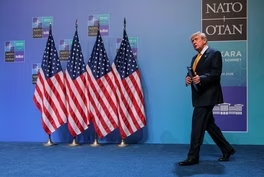
What NATO allies think about Trump's treatment of Canada
Video has Closed Captions
What are U.S. allies thinking about Trump's treatment of Canada and South Korea? (5m 46s)
Providing Support for PBS.org
Learn Moreabout PBS online sponsorship New Episode
- News and Public Affairs

Top journalists deliver compelling original analysis of the hour's headlines.
 New Episode
- News and Public Affairs

FRONTLINE is investigative journalism that questions, explains and changes our world.
 From My Station
 New Episode
 New Episode
 New Episode
 New Episode
 New Episode
 New Episode
 New Episode
Support for PBS provided by:
Major funding for “Washington Week with The Atlantic” is provided by Consumer Cellular, Otsuka, Kaiser Permanente, the Yuen Foundation, and the Corporation for Public Broadcasting.