
Market to Market - March 13, 2026
Season 51 Episode 5130 | 24m 45sVideo has Closed Captions
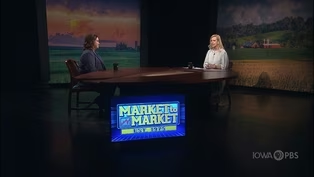
Commodity market analysis with Naomi Blohm.
The war brings volatile prices to La Salle Street and Main Street. Past failures in America’s land promise. Commodity market analysis with Naomi Blohm.
Problems playing video? | Closed Captioning Feedback
Problems playing video? | Closed Captioning Feedback
Market to Market is a local public television program presented by Iowa PBS
Market to Market - March 13, 2026
Season 51 Episode 5130 | 24m 45sVideo has Closed Captions
The war brings volatile prices to La Salle Street and Main Street. Past failures in America’s land promise. Commodity market analysis with Naomi Blohm.
Problems playing video? | Closed Captioning Feedback
How to Watch Market to Market
Market to Market is available to stream on pbs.org and the free PBS App, available on iPhone, Apple TV, Android TV, Android smartphones, Amazon Fire TV, Amazon Fire Tablet, Roku, Samsung Smart TV, and Vizio.
Providing Support for PBS.org
Learn Moreabout PBS online sponsorshipthe war brings volatile prices to LaSalle Street and Main Street.
A look at past failures in America's land promise and commodity market analysis with Naomi Blohm next.
>> [MUSIC] >> I wouldn't be here without my customers.
>> Yeah.
I'd like to thank the customers They're.
They're very dear to our hearts.
>> It's about the people that you're working with and the relationships that you have.
>> Thank you, thank you, thank you >> Thank you from the bottom of my heart.
>> [MUSIC] >> Tomorrow >> For over 100 years we've worked to help our customers be ready for tomorrow.
>> [MUSIC] >> Trust in tomorrow.
Information is available from a Grinnell Mutual agent today.
>> This is the Friday, March 13th edition of Market to Market, the weekly Journal of Rural America.
>> Hello, I'm Brooke Kohlsdorf Paul Yeager is on assignment.
Overall official numbers for inflation show a decline over the past 12 months.
Even with the data gap in October the Consumer Price index, a measure of inflation, increased 3/10 of a percent in January driven in part by higher food prices.
The annual rate has declined to 2.4%, just over a half percentage point from January 2025 Without food or energy.
The core CPI rose 2/10 of 1% and recorded an annual rate of 2.5%.
Next month's data will give some indication of how the war with Iran is affecting consumer prices.
Over the past 13 days, 140 members of the U.S.
military have been wounded and seven have lost their lives.
The average price of a gallon of gasoline has risen more than a quarter over the past week, and more than $0.60 when compared to a month ago.
While the pain at the pump is clearly visible, there is growing concern about the price of inputs and a potential shortfall in crop production.
Peter Tubbs has more.
>> This week, price spikes in agricultural inputs due to the conflict in the Persian Gulf caused one rural advocacy group to petition the white House for assistance.
Farm Bureau President Zippy Duvall sent a letter to President Trump asking for fertilizer deliveries to America's farmers, be prioritized as the war with Iran creates blockages in the delivery of key inputs Iran has reacted to American attacks by firing on and threatening to sink ships passing through the Strait of Hormuz, effectively closing shipping out of the Persian Gulf.
20% of the planet's oil passes through the strait along with half of the world's urea and 35% of all ammonia.
Exports of these critical inputs are at risk due to the conflict North American prices for urea have risen 25% since the United States began its bombing campaign March 1st.
The letter from the Farm Bureau proposes multiple paths, including using the U.S Navy to maintain shipping lanes through the Strait of Hormuz ensuring American transportation can move imported inputs to farmers and dropping tariffs on imported agricultural inputs.
The Farm Bureau is concerned that high input costs will hurt farm profitability and may reduce planted acres in multiple crops.
For market to market, I'm Peter Tubbs.
>> The farmer Bridge assistance payments promised to producers to help farmers who have shouldered low prices and the loss of export markets have been flowing to rural America.
The administration guaranteed 11 billion for row crops and an additional billion dollars for specialty crops in the federal government's past Several programs have not worked as smoothly.
Lawsuits in the late 90s revealed USDA had discriminated against black farmers, a landmark lawsuit ended with a $1 billion decision in favor of those farmers even further back.
Attempts to provide former enslaved peoples with farmland after the Civil War worked initially, but generally didn't last.
Colleen Bradford Krantz has more in our cover story >> This southwest Missouri farm near Ash Grove was home in the mid 1800s to Ruben Boone, an enslaved African American who initially worked the land for Nathan Boone, son of the famous Kentucky frontiersman Daniel Boone.
When the Civil War ended, measures enforced by the new Freedmen's Bureau briefly allowed former slaves like Ruben to petition for Confederates abandoned or confiscated farms in one of America's first attempts at land redistribution to formerly enslaved people.
But it largely failed.
>> This effort to enact new laws under reconstruction begins to lose momentum and go by the wayside.
By the mid 1870s.
>> The United States continues wrestling with how to address historical wrongs in agriculture without creating new inequities.
The USDA 2021 Loan Forgiveness Program for socially disadvantaged farmers was stalled after legal complaints of reverse discrimination in April of 1865, federal officials granted Ruben Boone's request to farm land owned by Howard Boone one of Daniel Boone's grandsons who was considered to be a Confederate sympathizer.
In exchange, under the one year agreement, the federal government would receive one third of his crop within a month, a different family asked to farm the land, but officials denied their request, citing the commitment to Ruben.
It was around this time that someone wrote to federal officials to say Ruben was worthy of protection, and some of his white neighbors are trying to drive him off.
The economic pressure also would have been immense as Ruben Boone tried to run a farm that had previously survived on unpaid labor.
>> If you're a formerly enslaved person and you've gained your freedom, your emancipation, you have no tools, you have no animals, and you have no seed.
So in many cases, you are starting literally from scratch.
You know, you have to rent from people, the land you have to rent or borrow the tools or pay for them on credit, and you're already in debt in a lot of ways.
And now it becomes an issue to where, you know, so much of your crop then has to be given over to pay your debts.
>> Facing these pressures, it's unclear whether Ruben gave up or was not offered an extension.
He and his wife eventually moved to Saint Louis, where the 1870 census lists his occupation as farmer, though he was likely a farmer without land after Republican President Abraham Lincoln was assassinated in April 1865 just two weeks after Ruben was granted access to the Missouri land, Andrew Johnson, a Democrat, came to power and began to undo Lincoln's Post-emancipation work.
He effectively overrode the field order that included the 40 acre promise that was intended to give land to freed slaves >> Many former Confederates go to Johnson and lobby for their return to power.
The return of their rights, and he relatively quickly grants them those rights.
And what you see in some instances, especially in the Carolinas, is formerly enslaved.
People who had worked on these plantations were given land, and then within the span of 18 months, you know, a year and a half, that land is taken back from them and returned back to the original slave owner.
>> Similar stories of lost opportunity played out across the country, affecting families for generations.
Annette Holmes of Antioch, California wonders how different her life might have been had her family been able to keep their land.
One side of her family descends from enslaved African Americans who were initially on a South Carolina cotton plantation and by 1793, on a rice plantation on Butler Island in coastal Georgia.
The rice mill smokestack still stands where Holmes's ancestors likely worked >> So my family lived there for years until the weeping time happened when they were sold.
>> The weeping time refers to an 1859 Savannah auction, where more than 400 enslaved people were sold Holmes's ancestors were taken to Louisiana >> When I first saw the list with my great great grandparents and their children it was like, wow once you have a name and then they have the price next to their name for like $510, and it's a different ball game when you know who it is.
>> Holmes's great grandfather, Jim Butler, later owned land in Louisiana near the Red River, but lost it in a legal battle in 1913 The lawsuit shows.
Butler sued a man who had offered to help him with a debt through a land lease agreement, but that man later claimed it was a purchase >> My great grandfather argued that no, this was my land.
And I think what happened because according to my grandfather, there was oil on that land.
So they found the oil.
And so Mr.
Marston claimed that he knew nothing about the oil.
>> A Louisiana judge sided with Marston in Holmes's family law.
It was yet another government disappointment that affected her family.
She lauds USDA however, for distributing over $2 billion to more than 43,000 black and other minority farmers in 2024.
The method the federal government has used to address what the agency acknowledged was systemic discrimination in more recent decades.
>> There's a lot of people that, you know why should we have to pay anything for something that we didn't do?
You know the taxpayer has to pay for it.
That's why when the United States government gets it wrong, everyone should jump up and holler because we're going to pay for it down the line some kind of way.
The nation is a 250 year old body that has to pay for its past injustices, and you are the taxpayer.
It's just disperse.
>> Holmes didn't benefit and isn't waiting around for help.
>> The opportunity missed is the generational wealth piece, right?
Land was wealth and it is.
Well that's why immigration opened up here.
The selling point is we can give you some land, right?
We can give you some land that didn't really belong to you.
You know it was native land.
And you can come in and live out your dream.
And we we miss that.
And so at this point, you know what would you give at this point?
It's like, you know, self reparations is the key How do we, we repair ourselves And, and that's what I'm looking into now.
>> For market to market.
I'm Colleen Bradford Krantz.
>> Next the market to market report.
>> We are recording on Thursday this week due to changes in our production schedule, the war with Iran continues to put pressure on the market.
This is coupled with a temporary stoppage of soybean exports from Brazil and a return of severe winter weather across the United States for transactions printed on March 12th The nearby wheat contract lost $0.18, and the May corn contract gained $0.02.
Reuters is reporting that Cargill's Brazil operation temporarily paused soybean shipments to China The move came after new rules were implemented to reduce pests and weeds in each load.
The May soybean contract added $0.27, while May meal rose by $3 per ton.
May cotton expanded $0.94 per hundred weight, and over in the dairy parlor.
April April class three milk futures cut $0.66.
The livestock market was down on Thursday April.
Cattle shed $3.33.
April feeders fell $8.63 and the April lean hog Contract dropped $1.28 In the currency markets.
The U.S.
dollar index moved 75 ticks higher.
April crude oil found $3.35 per barrel Comex gold fell $53.40 per ounce, and the Goldman Sachs Commodity Index was up by more than 25 points to settle at $6.97 91.
And here.
Now, to lend us her insight on these and other trends is Naomi Blohm.
Thanks for being here, Naomi.
>> Yeah thanks for having me >> We have a few things to talk about.
Right I don't even know where to begin.
So we're now almost entering our third week of the war in Iran So oil was kind of all eyes were on oil this week.
It went up to 100, almost $120 a barrel at one point came back down, went back up.
Is oil guiding the grain markets?
>> Absolutely.
Right.
Now this is our black swan event of the year so far.
And you know, you think back to just a few weeks ago and the outlook for the grain market was still leaning negative with large global supplies, large U.S supplies.
But now with the threat of crude oil rallying and and potentially not getting some of the fertilizers into the country that they were talking about earlier on the show the market is waking up.
So we're seeing the funds exit, the hefty short positions that they had in the corn market and the wheat market going to more of a neutral stance.
And for the grain markets right now, we're waiting for a few things.
We're waiting and watching crude oil And the biggest thing to take away right now is that if crude oil trades through $125 a barrel, and you're right, we got up to near 120 on Sunday night.
But if we go through $125 a barrel, then we would be taking out a downtrend line that had been established since 2008.
That would lead to more technical buying for crude oil, more fund buying for crude oil that spills over to the grains And if crude oil works higher, then you're going to see December corn blast through $5 resistance.
You'll see November beans blast through $12 resistance and you're going to start to see panic in the world.
And that's really going to shift the dynamic pace of this market.
Then in a couple of weeks, the other things we have to be watching for corn and soybeans we have to be keeping an eye on the weather in Brazil as they're finishing soybean harvest.
Second crop corn getting closer to three quarters planted, and it's going to be getting into pollination season there.
If there's any weather issues there and it's getting drier the market's going to really respond with higher values as well because global supplies of corn are actually dwindling a little bit lower over the past 5 or 6 years.
So this is setting up to be something very potentially substantial.
And then you have the Planted Acres report on March 31st.
So what had been just such a bearish sentiment back in January might be turning into something absolutely unexpected for 2026 >> And one of those unexpected things with oil being so high is fuel prices and diesel prices up.
Even if the war ended today, how long would it take for prices to come back down?
>> Yeah, I would say if the war were to end, you know, over the next few days, it's probably going to take, you know, 3 to 4 weeks to try to get that price at the pump to come back down.
And these poor farmers with the heating oil futures going through the roof that's taking the diesel prices higher.
And they're starting to think about what their needs are for spring and spring planting And the inputs are already horrifically expensive.
And now getting to the point where they can be even more expensive So there might be last minute shifts of acreage Yet for the spring, because we continue to hear how high it is for prices and inputs for corn and corn planting that we might all of a sudden see a bigger shift to soybeans than expected.
It'd be very curious to see what they say on March 31st.
And then what actually transpires in the spring.
>> Okay, that fertilizer story, we've we've known about this for a little while in the ag community It's now kind of making national news.
And is all of that attention putting more pressure on the markets in some way then?
>> Yeah.
So what's happening then?
It's giving more incentive for the funds to definitely maintain a neutral position with corn right now.
Because if that fertilizer doesn't get here or if it gets here, then the cost is too high.
There's of course, then the, the temptation for producers to not put as much fertilizer on because they can't afford it.
So if we don't have that on there, then we're not going to have those record yields that the USDA thinks that we could have So there could be a possibility of lower production in the United States just because of the cost of fertilizer.
>> Okay.
So is corn the the grain that's mostly tied or most closely tied to what oil does?
>> Yeah, very much so.
And of course, a portion of that is just because of how corn is used for ethanol.
And it's a part of an energy.
But the other portion of that is the fund balancing their portfolios.
And a lot of times they'll have a bushel basket of commodities.
And if they're buying more crude oil, then a lot of times they'll start to take the grains higher as well.
>> All right.
I have a question from social media.
This is Glenn in Ohio.
And he says how many black swan events does it take to make a flock?
We're surrounded by increasing market volatility combined with strong corn demand.
And we haven't experienced any weather related events yet.
You kind of alluded to this earlier.
>> Yeah.
So we are definitely in that black swan situation with the conflict with Iran.
The next part of that would be the higher fertilizer costs.
And to his point if we get into a weather issue with Brazil on that second crop, corn or potentially anywhere in the world with wheat as the wheats coming out of out of winter dormancy, and especially the United States, the spring or summer, then you're really going to see the funds.
Want to take the market to a longer position.
And remember when they go along with corn for funds, their long 350,000 contracts.
And right now they're just long, maybe 30, 40,000 contracts.
So there's room for this market to run.
If the fundamentals if our black swans kind of continue to flock together.
>> With soybeans.
We heard earlier in the show that Cargill had halted shipment of Brazil corn or soybeans to China.
Is that something we really need to keep an eye on?
>> Well, it makes you wonder, you know, is there, you know deeper political connections and ties to it.
The segue to that would then be President Trump still potentially going to visit President XI in China at the end of March and early April.
And there still is the hope that China comes in and buys more American soybeans.
Ever since President Trump put on social media a few weeks back that he thought China would come in and buy 8 million more metric tons of soybeans, they haven't bought anything, so there still is, you know, the hope.
Do they get a trade deal done?
And the United States soybeans become a little bit more competitive.
But right now, the bottom line is that the soybeans in Brazil are about a dollar cheaper than the U.S.
market.
And I'm very curious to see what transpires out of what Cargill had done with the Brazil soybeans.
>> And there's a meeting this weekend as well, I think, with a couple of the leaders.
Right.
>> That's what I think I heard too.
So we'll see what happens.
You know it's always like on the weekends you're like, okay what's happening with the war?
And you want to like, you know, go with one eye open looking at the Sunday night grain trade and the Sunday night crude oil trade.
So absolutely, you have to keep tabs on markets and market news throughout the weekend as well.
>> You wrote that beef demand is really good right now.
Earlier this week with commodity prices a little higher and potentially fuel prices as well.
Where's the market going.
>> Yeah.
So I think we saw that this week with with cattle futures.
We had amazing weekly export sales for the cattle market.
And we know the domestic demand is strong But there's a very real correlation that if gas prices get too high, that the consumer has to check their budget and other places.
And so you could see, you know, people trying to then buy less expensive proteins at the grocery store to help you know, balance their budget, so to speak.
So the cattle market this week has tested support levels, major moving average support levels.
And we're waiting to see, I think what crude oil does If crude oil works higher.
I think you see funds reallocation where funds exit long cattle positions.
We start to see technical selling and we could see the cattle market slide lower fast.
Just on technical selling.
But we do need to keep an eye on what the consumer is doing, especially in the face of high crude oil prices.
>> Okay, so with all of that said what about the pork market right now?
Are more consumers?
Yeah.
Considering eating pork and is that impacting the market.
>> Well I think for sure.
And the hog futures prices have been trading near recent highs.
And we started to see that market back off a little bit too.
But you go to the grocery store and still, you know chicken is is less expensive than beef.
Pork varieties of pork still less expensive than beef.
So I think you are going to see that shift.
If the energy prices keep going higher.
And that'll be something to watch.
And export sales for pork this week were lower than normal.
So that was interesting to see.
But we'll see what the consumer does ultimately.
And it's all about crude oil right now That's our leading indicator for all of these markets.
>> I know this is kind of a big question to end with.
And we've only got about a minute But are there inflation fears at this point?
>> Yeah.
So actually there are.
And if you remember ahead of the or going into the Ukraine and Russia conflict there, coming out of Covid, there was the concern of inflation happening.
And so the funds bought commodities as a hedge against inflation and caused the inflation.
And so that concern is becoming real again where they're going to come in to some of these cheap agricultural commodities like cotton is cheap.
We have cheap corn, we have cheap wheat.
And they could push things higher if they decided to become buyers.
And then of course, that would spur inflation and all of that talk again.
So it's going to be a very, very I think, tumultuous next 2 to 3 weeks in the marketplace.
And again, we have to keep an eye not only with the conflict in Iran but what is going to be happening with President Trump and President XI because that is a huge global chess piece to this entire situation for how global trade is going to happen >> We got to a lot Naomi.
Thank you We'll continue in Market Plus All right.
You've been watching the analysis portion of our program.
And in a moment we'll continue our discussion in an online only segment.
You can find it by searching Market Plus with Naomi Blohm wherever you get your podcasts.
You can also go to our website at Markettomarket.org to listen.
And as a reminder this is the annual pledge period for many of our stations.
If you value this program, please call or make contact with your public TV station to offer your support You are the key in our continued coverage of rural America.
Next week a drug's expansion in the marketplace helps spur demand for animal protein.
Thanks for watching and have a great week.
>> [MUSIC] [MUSIC] [MUSIC] [MUSIC] [MUSIC] [MUSIC] >> Market to market is a production of Iowa PBS, which is solely responsible for its content.
>> [MUSIC] >> I wouldn't be here without my customers.
>> Yeah.
I'd like to thank the customers They're they're very dear to our hearts.
>> It's about the people that you're working with and the relationships that you have.
>> Thank you, thank you, thank you, thank you from the bottom of my heart >> [MUSIC] >> Tomorrow for over 100 years, we've worked to help our customers be ready for tomorrow.
Trust in tomorrow.
Information
 New
NewVideo has Closed Captions
Clip: S51 Ep5130 | 10m 46s | Naomi Blohm discusses the economic and commodity markets in this web-only feature. (10m 46s)
Providing Support for PBS.org
Learn Moreabout PBS online sponsorship
- News and Public Affairs

Top journalists deliver compelling original analysis of the hour's headlines.

- News and Public Affairs

FRONTLINE is investigative journalism that questions, explains and changes our world.












Support for PBS provided by:
Market to Market is a local public television program presented by Iowa PBS