
The Island Murder: Chapter 1
Clip: Season 30 | 9m 19sVideo has Closed Captions
The Island Murder: Chapter 1
Watch Chapter 1 of The Island Murder.
Problems playing video? | Closed Captioning Feedback
Problems playing video? | Closed Captioning Feedback
Corporate sponsorship for American Experience is provided by Liberty Mutual Insurance and Carlisle Companies. Major funding by the Alfred P. Sloan Foundation.
Support provided by:


The Island Murder: Chapter 1
Clip: Season 30 | 9m 19sVideo has Closed Captions
Watch Chapter 1 of The Island Murder.
Problems playing video? | Closed Captioning Feedback
Where to Watch American Experience
American Experience is available to stream on pbs.org and the PBS app.
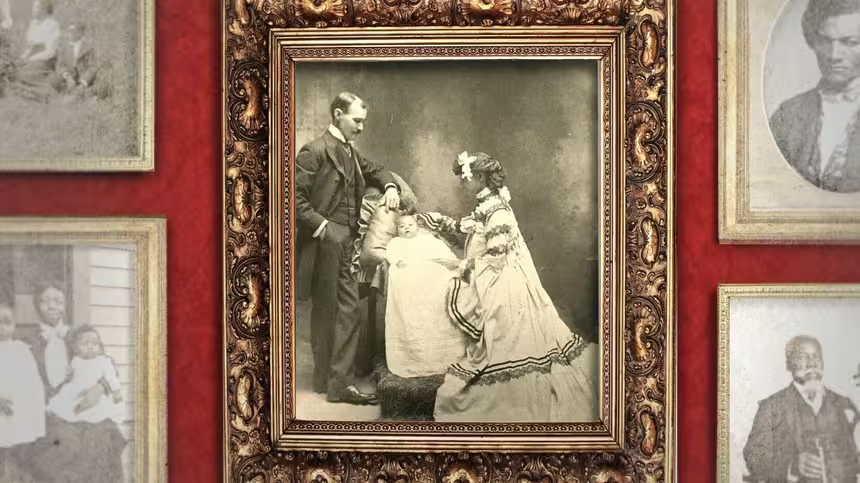
When is a photo an act of resistance?
For families that just decades earlier were torn apart by chattel slavery, being photographed together was proof of their resilience.Providing Support for PBS.org
Learn Moreabout PBS online sponsorship♪ ♪ (waves crashing) NARRATOR: In the waning days of summer 1931, the false calm of Honolulu, Hawaii, was shattered by a single allegation made by a 20-year-old Navy wife.
MAN: She says she was kidnapped.
She was taken to this area down on Ala Moana, dragged in and raped six or seven times.
This is a total shock, because in the entire history of Hawaii, as far as anybody has been able to find out, no Hawaiian individually ever assaulted a white woman before.
(flash bulb pop) Here is a gang of them supposedly doing it.
WOMAN: Creating this story caused not only the disruption of a community like no other except Pearl Harbor, but also the death of an innocent young man.
(engine puttering) ♪ ♪ NARRATOR: The quiet whisper of the initial lie grew to a clangorous din of power politics and racism-- an ugly noise that resounded through this placid-looking tropical community and then to the marbled echo chambers of the White House, the War Department, and the United States Senate.
The story of the Navy wife and her alleged assailants jumped from the local Hawaiian newspapers to front pages across the United States, fetching the attention of President Herbert Hoover, media baron William Randolph Hearst, and the country's first celebrity attorney, Clarence Darrow.
The proceedings were watched by everyone from the social-register elite in New York, Washington, and San Francisco to the working class in Honolulu's low-rent districts.
For anybody who saw it plain, the case revealed cold, hard truths about America... and the people who ruled it.
♪ ♪ ♪ ♪ NARRATOR: It was already a beautiful escape, this island city in the middle of the Pacific.
2,000 miles from the California coast, it was America but with better weather.
And it was run by white people, or "haoles," as the natives called them.
♪ ♪ In the summer of 1931, wealthy tourists were gliding into Honolulu Harbor and then on to Waikiki Beach, where the beautiful young Hawaiians stood ready to serve.
♪ ♪ MAN: If you need an umbrella to be pitched and speared into the sand, or if you need a cool drink, or if you need to get surfboard lessons or ride a canoe-- anything that you need to do that involves frolicking, the beach boys are there to satisfy.
And it's said that they certainly did satisfy.
NARRATOR: Keeping the tourists satisfied was a job that paid, but there was only so much beach, so most of the working class kept to their own neighborhoods.
Beyond pool halls and barefoot football, there was little to do in those places.
(crowd cheering ) Young men could scratch up a Depression-era job at the nearby docks or in construction or at the Dole pineapple cannery.
The lucky ones might even pluck one of the plum spots at the police or parks departments, but more and more, those spoils were going to newly arrived haoles.
So most young men in neighborhoods like Kalihi, Palama, and Iwilei were at loose ends.
MAN: These were desperately, desperately poor places.
The streets were so narrow you couldn't get a car into them.
They were also where the casual prostitution was, so on payday they were filled with sailors and soldiers who were crawling around looking for a little action.
This was the community that these guys grew up in-- without jobs, with a lot of resentment for the military, who they saw around them all the time.
(distant shouting) WOMAN: There was a real strong sense of racism coming at us from the military.
They were almost entirely haole young men, and a lot of them were Southern, so they had this idea that Hawaiians shouldn't be out and about, having a government, having a good time in Honolulu.
(yelling and laughing ) NARRATOR: Dark-skinned men frolicking in public with white women was too much for many soldiers and sailors.
And the military men knew when they were being made fun of by the beach crowd at Waikiki.
But locals didn't push too far.
There were simply too many servicemen for safety.
In 1931, there were 20,000 in the Islands, and more were on the way.
Any Saturday night, Honolulu's streets, speakeasies, and restaurants were crawling with off-duty soldiers and sailors.
(birds chirping) On September 12, 1931, a Kentucky-born Annapolis graduate named Thomas Massie and his 20-year-old wife Thalia were among the Navy crowd at a Honolulu night spot called the Ala Wai Inn.
The lieutenant had insisted they go, and she was not happy to be there.
WOMAN: She was from a privileged family and I think she felt she was perhaps slightly socially superior and didn't like to mix too much with the Navy crowd.
STANNARD: Other people in the military would complain that she would go to parties with Tommy, they would fight, she'd bite him, throw things, and then storm out into the night.
He had told her recently that he wanted a divorce.
She was terribly upset about the possibility of divorce and so she had agreed to a compromise.
He would put her on probation, and if she didn't behave properly, then she would go home to her parents.
She didn't want to go to that dance, but she agreed to try to keep their marriage together.
BLACK: That night she wandered from room to room and wasn't always welcomed.
In fact, there was an incident in which one of the naval officers told her she wasn't popular, and she slapped him.
And she walked out into the night before the party was over.
She walked in an area that had a rather unsavory reputation... and, um, somebody did see her.
Two people said that she was being followed by a haole man.
STANNARD: Tommy, meanwhile, pretty much didn't notice that she was even gone.
This was something she did all the time, so he didn't pay much attention to it until 1:00 when everybody was finally breaking up and he decided to make a phone call to her at home just see if she's there.
And she was not there.
NARRATOR: It was nearly 2:00 in the morning and nearly two hours after she'd stormed out of the Ala Wai when Tommie finally got her on the phone.
She was hysterical and begged him to hurry home, and when he arrived, she told him she'd been assaulted.
Over her objections, Thomas Massie called the police.


Harry Houdini's Impulse to Escape
Clip: S30 | 1m 38s | Harry Houdini's impulse to escape dangerous situations attracted thousands of spectators. (1m 38s)

Genetic Screening: Controlling Heredity
Video has Closed Captions
Clip: S30 | 11m 12s | The ability to prevent suffering through genetic screenings sparks difficult questions. (11m 12s)
Video has Closed Captions
Preview: S30 | 30s | The shocking history of the early 20th-century campaign to breed a “better” American race. (30s)
The Eugenics Crusade: Chapter 1
Video has Closed Captions
Clip: S30 | 8m 38s | Watch Chapter 1 of The Eugenics Crusade. (8m 38s)
Clip: S30 | 1m 19s | Besides inventing Corn Flakes, John Kellogg helped promote the American Eugenics movement. (1m 19s)
P.G. Lowery and the Spread of African-American Music
Clip: S30 | 2m 47s | P.G. Lowery’s all-black band gained early twentieth century fame through the circus. (2m 47s)
Video has Closed Captions
Clip: S30 | 9m 32s | The Circus, Part 2: Chapter 1 (9m 32s)
Clip: S30 | 30s | Revisit the heyday of America’s traveling circus and meet the showmen who created it. (30s)
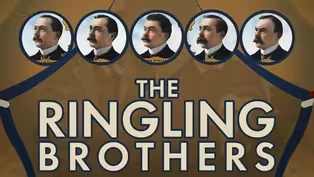
Clip: S30 | 1m 14s | The Ringling Brothers expanded from a tiny regional circus to this large traveling circus. (1m 14s)
Clip: S30 | 1m 23s | Phineas Taylor Barnum, properly known as P.T. Barnum, was a showman. (1m 23s)
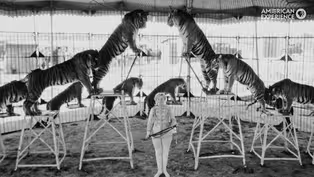
Clip: S30 | 1m 23s | Mable Stark was one of the 20th century's most famous cat trainers. (1m 23s)
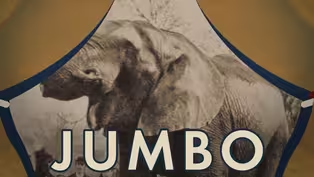
Clip: S30 | 1m 21s | The sale of Jumbo, the African elephant to P.T. Barnum causes an uproar in England. (1m 21s)
Preview: S30 | 30s | Explore the history of this popular, influential and distinctly American form of entertain (30s)
Video has Closed Captions
Clip: S30 | 9m 22s | Watch Chapter 1 of The Circus. (9m 22s)
Clip: S30 | 30s | Explore the early days of this popular, influential and distinctly American form of entert (30s)
The Circus | Coming October 2018
Preview: S30 | 1m | "The Circus" explores the history of this distinctly popular American entertainment. (1m)
Clip: S30 | 1m 25s | In 1910, Charles Davenport founded Eugenics Record Office to collect human heredity data. (1m 25s)
Clip: S30 | 8m 32s | Explore today's social circus movement through the eyes of Sidney “Iking” Bateman. (8m 32s)
Eugene O'Neill: Playwright and Nobel laureate
Clip: S30 | 2m 21s | Pulitzer prize winner & Nobel laureate, Eugene O’Neill revolutionized the American stage. (2m 21s)
Clip: S30 | 2m 31s | Seemingly impervious to injury or illness, Yankee slugger Lou Gehrig never missed a game. (2m 31s)
Clip: S30 | 2m 6s | In 2001, George H.W. Bush wrote a letter for history, addressed to his children. (2m 6s)
Hoops and Laughter: The Harlem Globetrotters
Clip: S30 | 3m 33s | A team of African American basketball players from Chicago began touring the Midwest as tc (3m 33s)

Preview: S30 | 20s | After his brother was assassinated, Robert F. Kennedy struggled to find his voice. (20s)
Clip: S30 | 2m 32s | On April 4, 1968, RFK delivered the news of Dr. King’s assassination in Indianapolis. (2m 32s)
Video has Closed Captions
Clip: S30 | 2m 39s | In 1898, the Supreme Court ruled that Wong Kim Ark had acquired U.S. citizenship at birth. (2m 39s)

Clip: S30 | 35s | In 1882, President Chester A. Arthur signed into law the Chinese Exclusion Act. (35s)
The Chinese Exclusion Act: Promo
Preview: S30 | 30s | On May 6, 1882, President Chester A. Arthur signed into law The Chinese Exclusion Act. (30s)
The Chinese Exclusion Act: Preview
Preview: S30 | 3m 18s | Watch a preview of The Chinese Exclusion Act. (3m 18s)
The Chinese Exclusion Act: Chapter 1
Video has Closed Captions
Clip: S30 | 9m 16s | Watch Chapter 1 of The Chinese Exclusion Act. (9m 16s)
Clip: S30 | 2m 1s | In April 1933, the Barrow gang holed up in Joplin, Missouri for a break from the road. (2m 1s)
Clip: S30 | 2m 26s | In 1925, the “Scopes Monkey Trial” pit traditional Christian beliefs against evolution. (2m 26s)
Clip: S30 | 1m 13s | Max Schmeling convinced the U.S. Olympic Committee to attend the 1936 Olympic games. (1m 13s)
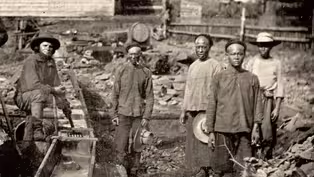
PBS Previews: The Chinese Exclusion Act
Video has Closed Captions
Preview: S30 | 1m 30s | Get an inside look at the making of The Chinese Exclusion Act, premiering May 29 at 8/7c. (1m 30s)
Clip: S30 | 50s | The Hawaiian people had done everything in their power not to be annexed by the U.S. (50s)
Preview: S30 | 30s | A young Navy wife made a drastic rape allegation against five nonwhite Hawaiians in 1931. (30s)
 Now Playing
Video has Closed Captions
Clip: S30 | 9m 19s | The Island Murder: Chapter 1 (9m 19s)

First White Settlers in Hawai’i
Clip: S30 | 1m 8s | The first white Americans to settle in the Islands arrived in the 1820s. (1m 8s)
Clip: S30 | 5m 33s | Who is this? Our team turned to Facebook, then headed to Memphis to find out. (5m 33s)

Clip: S30 | 2m 18s | Fifty years after Dr. King's assassination, two long-time Memphis residents talk about the (2m 18s)
Clip: S30 | 1m 15s | The assassination of Dr. Martin Luther King forever bound the two men in history. (1m 15s)
Clip: S30 | 1m 39s | Many feared the 1919 raids went too far — violating the civil liberties of people. (1m 39s)
Clip: S30 | 1m 25s | The law school grad was asked to run the “Radical Division” at the Justice Department. (1m 25s)
Clip: S30 | 1m 26s | In 1919, A. Mitchell Palmer created the “Radical Division” within the Justice Department. (1m 26s)
Mary Elizabeth Lease: The Advocate
Clip: S30 | 1m 32s | Women couldn’t run for elected office in Kansas, but Mary Elizabeth Lease was a force. (1m 32s)
Clip: S30 | 1m 9s | When one of the richest men in America feared a collapse of the U.S. dollar, he had a plan (1m 9s)
Henry George: From Poverty to Politics
Clip: S30 | 1m 35s | Henry George’s message about the haves and the have nots helped ignite a movement. (1m 35s)
Clip: S30 | 1m 8s | The Gilded Age entrepreneur offered a workplace that was guided by the golden rule. (1m 8s)

Video has Closed Captions
Clip: S30 | 10m 6s | Watch Chapter 1 of The Gilded Age. (10m 6s)
Providing Support for PBS.org
Learn Moreabout PBS online sponsorship










Support for PBS provided by:
Corporate sponsorship for American Experience is provided by Liberty Mutual Insurance and Carlisle Companies. Major funding by the Alfred P. Sloan Foundation.