Prairie Yard & Garden
Pruning Hydrangea
Season 39 Episode 11 | 28m 45sVideo has Closed Captions
Meet Audrey Busch at the Minnesota Landscape Arboretum, where she cares for hundreds of hydrangeas.
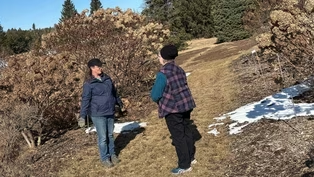
Host Mary Holm visits Audrey Busch at the Minnesota Landscape Arboretum, where Audrey oversees hundreds of hydrangeas. Audrey demonstrates precisely when and how to prune these popular shrubs to ensure maximum flower power in your own garden.
Problems playing video? | Closed Captioning Feedback
Problems playing video? | Closed Captioning Feedback
Prairie Yard & Garden is a local public television program presented by Pioneer PBS
Production sponsorship is provided by Shalom Hill Farm, Heartland Motor Company, North Dakota State University, Friends of Prairie Yard & Garden, and viewers like you.
Support provided by:


Prairie Yard & Garden
Pruning Hydrangea
Season 39 Episode 11 | 28m 45sVideo has Closed Captions
Host Mary Holm visits Audrey Busch at the Minnesota Landscape Arboretum, where Audrey oversees hundreds of hydrangeas. Audrey demonstrates precisely when and how to prune these popular shrubs to ensure maximum flower power in your own garden.
Problems playing video? | Closed Captioning Feedback
How to Watch Prairie Yard & Garden
Prairie Yard & Garden is available to stream on pbs.org and the free PBS App, available on iPhone, Apple TV, Android TV, Android smartphones, Amazon Fire TV, Amazon Fire Tablet, Roku, Samsung Smart TV, and Vizio.
Visit the Prairie Yard & Garden Website
Do you love gardening? Consider becoming a friend of Prairie Yard & Garden to support this show and receive gifts with your contribution. Visit the link below to do so or visit pioneer.org/donate.Providing Support for PBS.org
Learn Moreabout PBS online sponsorship(gentle music) - Two years ago, we did a show on varieties of Hydrangea with Debbie Lonnee of Bailey Nurseries.
She did a marvelous job, and that show has been viewed over 15,000 times.
Lots of people have told me they were inspired to plant Hydrangea after watching that show, but now they had another question.
How do you prune them?
Well, let's go get that answer today as we head to the Minnesota Landscape Arboretum to ask and learn.
- [Announcer] Funding for "Prairie Yard & Garden" is provided by Heartland Motor Company, providing service to Minnesota and the Dakotas for over 30 years, in the heart of Truck Country, Heartland Motor Company, we have your best interest at heart.
North Dakota State University, through its Field to Fork educational program, providing research based information on growing, preparing, and preserving fruits and vegetables.
Mark and Margaret Yackel-Juleen in honor of Shalom Hill Farm, a non-profit rural education retreat center in a beautiful prairie setting near Windom, Minnesota, and by Friends of Prairie Yard & Garden, a community of supporters like you who engage in the long-term growth of the series.
To become a friend of Prairie Yard & Garden, visit pioneer.org/pyg.
(bright music) - Since I get questions on pruning Hydrangea, I thought, who has lots of plants that could give us a lesson on that very topic?
Well, duh.
I remember the Minnesota Landscape Arboretum has a whole Hydrangea section, so I called and was referred to Audrey Busch.
She said that they would be pruning like crazy and we could come to watch and learn.
Thanks so much, Audrey, for letting us come out and see all your Hydrangeas and learn today.
- Yeah, we're so glad to have you, and it's a beautiful, perfect mid-winter spring-ish day to do this.
- What is your background?
- I have a background, a lot of growing things.
So, initially, I grew up on a farm in Wisconsin, so lots of plants of all different sorts, and the seasons and animals.
River Falls is a really wonderful university.
They're known for agriculture, horticulture, and education.
So my first degree was in education.
And then after quite some time I went back to school and I got degrees in landscape design and construction and a second degree in horticulture.
And as a pair, they work really, really well together.
And then especially education learning piece of things, that was really helpful too.
- So, how did you end up here at the arboretum?
- Yes, there was just a job opening.
It was an assistant gardener, so I took the assistant gardener job and eventually worked into becoming a horticulturist.
So that's what I do now, and it covers a lot of different areas.
Yeah, the gardens that I take care of are between the gardens and shrub collections.
It's about 19 different areas.
So it's a wide range and it's a variety.
It's like a smorgasbord of plant maintenance.
So it's really fabulous to work here.
- [Mary Holm] So what are the main types of Hydrangea?
If we can just back up just a step, in Minnesota, there are Hydrangeas, and we have USDA zones for our temperature and climate.
Some of you that may be watching from Minnesota may be in a zone three, some are zone four, and a few people might be in zone five.
So within that range, we can safely say we have certain Hydrangeas.
South of Minnesota, there are Hydrangeas that will not grow here.
So, Minnesota, we have the Hydrangea paniculata, we have Hydrangea arborescens, and we also have macrophylla.
So Hydrangea macrophylla, some are zone four and summer zone five.
- [Mary Holm] If people have bought a property and there is an existing Hydrangea, how can they figure out what they've got?
- Well, if it's this time of year, you can tell a lot by the flower heads.
Often, no one that's moving out is gonna have done a fall cleanup.
They just wanna move in, and the last thing on their list is pruning Hydrangeas.
So in the spring, if they were to look like this, you can determine a lot about the form of the flower head.
Panicle paniculata, I like to tell people you can remember it's a little bit more pointy.
The arborescens, arbor, it's gonna be a lot more smooth rounded head, and then this is what's left of the macrophyllas.
So if you didn't have this whole entire shrub area to look at, compare that.
Paniculatas, a good way to think about that is being pointed.
Arborescens are around.
The macrophylla would be round, but at this time of year you'll see a lot of the shrubs here... And all of them have tags.
If you wanted to come look here, the tags will tell you this is a macrophylla, and most of these flower heads, because they're so dense, they flew off.
Now that's not a scientific way.
The macrophylla, many of them, I think all but one, will have a color to them.
And the old wood and the new wood would be on that shrub, and you can see the old and the new stalks on the same plant.
So another really great resource are the master gardeners in your county.
Most of the time you can call in, each county has the extension program, and they will connect you with a master gardener, and they're full of great information.
- [Mary Holm] About how many Hydrangea plants do you have here at the arboretum?
- [Audrey Busch] We have 139, and everyone has their own special ID.
They're not all right here, but we have quite a few.
- [Mary Holm] I'd like to learn a lot more about pruning.
Can we do that?
- [Audrey Busch] Sure, let's go get to it.
(bright music) - You've probably heard the saying, and apple a day keeps the doctor away.
While no food guarantees overall good health, apples are showing some promise in helping us in many ways.
For example, apples are rich in soluble fiber, and that could lower your blood cholesterol.
Apples also can help with blood glucose management among the who have diabetes.
Apples have also shown some ability to help with lung function, and they're rich in antioxidants, so they might even help prevent cancer.
A medium apple, about three inches in diameter has just a hundred calories plus vitamins, minerals, and a satisfying crunch.
They're easy to pack in a lunch, take on a hike, or slice up for an afternoon snack.
And the variety is incredible.
From sweeten and crisp Honeycrisp apples to tart Granny Smiths, there's one for almost every taste and recipe.
Try them baked with a little cinnamon dried for a chewy snack or cooked down into apple sauce.
You can even slice them into salads for a touch of natural sweetness.
When you take a bite of a fresh, crisp apple, you're enjoying a fruit that's been valued for centuries for its health benefits and taste.
I'm Dr.
Julie, bringing the feel to your fork.
Until next time.
(bright music) - [Mary Holm] Audrey, when is the best time to prune?
- Well, for these two types, paniculata and the arborescens, you can prune anytime late fall after they've defoliated, winter or spring, whenever it works into your schedule and the weather.
So, this wood is now from last year.
So this is old wood and this isn't going to produce the blooms.
New wood is what produces the blooms.
So we're gonna take this off.
It'd be best to get it done before anything buds out, before the leaves start growing.
And the same would be for the arborescens.
Macrophylla, which we'll come to later, has a different story.
because they bloom on some old and some new wood.
So you have both old wood and new wood in the same shrub and you will get new growth.
And so those blooms, if you cut off the old wood, you're also cutting off the buds for the new flowers.
- So what are the tools that you use for pruning?
- Well, we have several.
I have hand pruners here.
There's a shears.
that's a hand shears.
Okay.
So that's useful for certain things.
The other, it's called a lopper.
This can get bigger branches and stems than the pruner.
I also have a really, really helpful, this is also a hedger or pruner.
It will do the same thing that this does, but it's a lot easier if you have a bigger area.
We also will need a saw.
Different types are different for different people.
This is the kind that's really portable and easy for us.
That's called a hand saw.
And when you get into the base of some of these and some of these branches, you need a bigger tool.
You need a saw.
Before I start doing anything, We'll give it a little sanitation.
This is isopropyl alcohol.
That's all we do.
That is to prevent disease from spreading.
If you had something here, it just sanitizes your tools.
I've already done that with my hedger.
I would do it with a lopper and I would do it from shrub to shrub.
So I'm gonna go ahead and show you.
On this one, this particular kind, I wanna keep a little bit of the structure for the new growth.
The old wood, I want it to be a framework for the new to grow on and kind of support the new growth.
So I'm gonna cut right now about a foot.
- [Mary Holm] How do you know how far down to cut for this?
- For arborescens, about a foot if you wanna keep that structure for the new growth to use.
You might think of a trellis.
So otherwise you can actually go six inch, six to eight to 12 inches, somewhere in there.
So if I just wanna keep doing this for all day long, we can do this one at a time.
There's nothing wrong with that.
But I'm gonna do an easier method because I have 138 more shrubs.
So if you can stand... Just be safe.
This is how I often do it.
(tool whirring) And then on the other side.
(tool whirring) And then any singles that are left, you can hand prune.
What that did is, besides it got it done quickly, they're all pretty even.
It's a nice rounded shape.
And I also have room to work on this paniculata.
- [Mary Holm] So this was probably kind of a type of an Annabelle or comparable to an Annabelle?
- [Audrey Busch] Yes, yes.
This is Invincibelle.
- [Mary Holm] Okay.
- It's a great plant.
It's a nice fill.
It does have a tendency to take as much room as it wants.
So in the next step, we'll take some of the paniculata off.
And I actually, for myself, I'm gonna use this.
We won't use the shears.
Those are not necessary.
Here I'm gonna get rid of... Simple as that.
So this is old wood, the new shoots that come out.
We not only wanna take these off to give room for the new growth, but we also don't want this to get misshapen or too tall.
This side is a little taller than that side.
So I actually... I'm gonna take a little bit more off this side than that side.
And I didn't talk about the angle, tipping it so that when you cut the branch, that has an angle to it, just about a quarter inch above the bud.
And what that will do is let any moisture roll out.
This has to harden into a callous and kinda heal itself.
So why do you wanna cut it above a bud?
You want the new bud to actually grow into something.
So if you cut it too close, it can damage the actual growing process.
If you cut it too far, it leaves a stub.
If we wanted to take this down and clean it up, so one thing I can do is to take this and get all these off so I can see the structure.
And while I'm here, I'm also gonna take this out because it's a little bit hard to see from there.
But this, in the wind, it's rubbed against this branch and it created a wound.
This is called a backwards facing branch.
So this needs to go because it's causing damage, and there's no reason that I can't go back and say, "Oh, that one wasn't quite short enough for my shaping."
- [Mary Holm] Audrey, sometimes on some of the Annabelle type, their blooms will flop so much.
- [Audrey Busch] Yes.
- [Mary Holm] Can the pruning help with that.
- Yes, there's two different kinds of pruning that you could do.
One is to leave some of these stems as support, but also those bloom heads are so big.
So if you were to say if this was that big, you could take off some of that.
These are made up of florets, so you can reduce the size and the weight without totally taking the whole head off.
And that often works.
If you have a really big rain, it's very windy.
that's a challenge.
It just will always be a challenge, but that definitely will help.
- [Mary Holm] Again, going back to an Annabelle type, a lot of times they turn green later on in the season.
- Yes.
- [Mary Holm] Why is that?
And if you prune those green ones off, will the white ones come back?
- [Audrey Busch] Well, first question is they turn green because that's natural.
That's a maturing of the flower head.
It's a common thing in flower.
So that color, it's normal.
There's nothing wrong.
And then as the whole plant shuts down for fall, that seed head will turn brown.
So if you look at this collection, they're all brown.
There's no chlorophyll left, and that's normal.
If you cut those off, you're not gonna get a huge amount of growth on that same branch.
But in general, those will have new ones already coming up, so they might be partially full at that time.
They would be white.
So they're staggered in their blooming.
And the thing about Hydrangea, some people love the look.
They love the seed heads green.
But if you're the kind of person that you'd like to clean it up and you want that seed head or that flower head to be gone and just tidy it up and get the fresh white coming, that's fine too.
It doesn't hurt the plant, and the plant's gonna keep going.
If the seed head is turned from white to green, the goal of a plant is to reproduce itself.
And so if the energy is being sent into creating seeds on those green heads, if that plant is trying to mature, it'd be better to cut those off so that the energy is sent to the white flower heads.
- My sister loves to clean everything up in the fall.
Is that okay to do?
- It sure is.
You can clean up in the fall if you want to.
You don't have to.
A lot of people love the look for the winter, The macrophylla, it's best to just leave them alone from mid-August and after.
You don't wanna clean those up or you won't get blooms.
You won't probably kill the plant, but you won't get your spring blooms that you're wishing for.
You will get new growth and you will get new flowers on the new growth.
But if you clean those macrophyllas up in the fall, you just cut down next year's flower heads.
- What are the reasons for pruning?
- If you had say an accident, a storm, and you had a big branch break, that would be a damage.
You'd wanna get rid of that because that branch is, it's cracked open.
It would be a place where disease or pests can get in and cause more of a problem.
It's also unsightly to have a broken branch.
So damage, a disease.
If you saw that, say this had some sort of disease, you wanna prune that off.
And the other would be if it's dead, and these dead, diseased, and damage, you can prune any time of the year.
Just make sure you use your spray to sanitize your tools.
And say it was March and this broke, or say it was August and it broke, you would wanna take it off.
- Okay.
What if the critters get after 'em in the winter time or in the spring?
- Well that happens.
There isn't anything you can do to remedy that after the fact.
You would wanna put in your garden notes what you saw, your phenology.
What did you see?
What happened?
What do I need to do next October to prevent that?
And usually it's like a steak and chicken wire.
We have different... We have deer and rabbit here, so it depends on your pest.
- Now, I have heard that there is a difference between shaping and rejuvenation.
Can you explain that?
- Sure.
Well, actually this is a really good example of shaping.
I had to shape.
If you look at the overall form of this, it was a little high on this side, and sometimes branches do that.
The sun's there.
It gets a little more sun.
That's a shaping.
There are also elements in here where there are different branches going wrong ways.
So I wanna shape that.
The rejuvenation would be if you have a little bit of an older shrub and it's gotten like leggy.
It's a little too tall and you wanna clean it up and tighten it up, you just would cut the whole thing back to the same basic six to eight inches above the ground.
And then it gives a new fresh growth.
- [Mary Holm] Okay.
I have also seen that there's what used to be one plant all of a sudden is now much bigger.
- Yes.
Oftentimes because Hydrangeas, the way their roots grow, they will get underneath the mulch and they will spring up a new branch.
We wanna cut that, and otherwise what you're gonna end up with is a really nice shape of a shrub.
So you wanna clean that up and literally cut it, like dig away a little bit, cut it, and then dig it out.
- [Mary Holm] You made this look so easy.
This is gonna be so great for our viewers.
- [Audrey Busch] And it was fun too.
It was satisfying.
If you have the right tools and you have good weather, it is kind of fun.
(gentle music) - I have a question.
I'd like to grow some more annuals in my flowerbed.
What are some considerations I should think about?
- When you grow annuals at your home, you need to think about whether or not those plants are gonna be in full sun, some shade, or full shade.
That will help you decide when you go to the store which ones to choose, so sun or shade.
The second thing to think about is the size of the plants or the container that you're gonna put them in.
Are they small, under 12 inches, medium or large?
From there you just have to choose your quantity.
Here we plant in large scale to have really bold impact and you can recreate that at home.
It takes a large number of plants.
Or, in a container, you can choose a small number of plants.
Here in front of us, we have a full sun plant called salvia.
I use a butter knife to get the plant out of the container that you've chosen to purchase.
So that when you lift it out, you retain the roots.
You do want to rough those roots up a little bit.
You can take your butter knife and kind of break those roots apart.
It helps the plant to grow outward rather than to stay contained in that cell.
And then you wanna dig your hole.
I have a soil knife, my favorite garden tool, and plant the plant just slightly below the soil line that is natural in your garden.
Make sure that you cover the top of the plant soil from the tray with in-ground soil to help retain moisture.
Once you have it in ground, give it a little bit of a firm so that it can't easily be plucked out by a creature that we all detest.
And then from there, one last thing that's hard for people to do, you need to actually pinch off those blooms, cut back to the first leaf.
And what this does is, while this plant is freshly planted, it has its growth energy being directed either into blooming or into rooting.
And when you've just planted something, you want the plant to put its energy into rooting so that it can establish strongly and last for as long as it can throughout the season.
Within a week or two, guaranteed, the plant that you've pinched will be blooming again and will bloom well throughout the rest of the season.
- Can you prune too much?
- Well, if you did, yes, you could damage the plant.
So take it easy, especially if you are on the new side.
If you prune too far to the ground and take too much away, that plant doesn't have any way to make energy.
The leaves are what's gonna make energy.
So you can't prune too much.
So never take more than... Take about a third or less.
- [Mary Holm] When you're done pruning, should you put pruning sealer on?
- No.
So, plants, generally, they will be able to heal themselves if you just let them do it, so you don't need to have any spray, any sealer, anything like that.
So remember you've sprayed your tools so they're sanitized, and the plant will take over and do what it needs to form a callus in that branch that you've taken away.
- [Mary Holm] Sometimes I've seen Hydrangeas that just get huge.
- Yes.
- [Mary Holm] How do you contain those, or what can you do?
- [Audrey Busch] For some varieties, that is natural, And you would decide how big you want that space to be.
Say you have something on this side or something on this side, you decide and then you could literally dig out the edges, dig them out, because Hydrangeas have shallow roots, and they will creep along, and they will try to get bigger and bigger.
Certain ones, not all of them, but certain ones.
So you would just trim that down and then tidy up your edges, just like a lot of plants, - [Mary Holm] Should you ever thin them out?
- [Audrey Busch] Yes, the canes from the center, if you keep getting more of those, you will wanna thin those out.
So thin out about a third.
So the same thing would apply to whatever you're gonna take out that's live wood.
For the paniculata and for the arborescens, you could take that out late fall, winter, and spring.
Macrophylla, you would wanna do it after they're done blooming, but before mid-August.
So when they have blooms, you can take just the top you.
If you wanna deadhead some of those rebloomers that are so fantastic, they'll have more blooms coming.
If you wanna take the spent blooms or the ones that are dying, take those off.
You can do that, but take 'em right close to the flower head.
- [Mary Holm] I have seen Hydrangeas that there's just kind of one stem and then there's the blooms on top.
- [Audrey Busch] Yes.
- [Mary Holm] Can you talk about those a little?
- [Audrey Busch] Sure.
So that is a tree form.
So that's still a shrub.
It's still a Hydrangea, but when that Hydrangea was very young in the nursery or where it was being grown, it would naturally have had several branches or trunks.
So all but one would've been pruned away.
So in a two or three or four years, that becomes one trunk and then you will get branching from that.
That's called a standard.
And so it's the same kind, but it was just shaped in such a way to produce a tree-like look.
So it's still a shrub, but it's a tree form.
- Okay, we've done all the pruning.
Should you water and fertilize to help them recover.
- We don't fertilize with a regular fertilizer here.
So if you're pruning, you're forcing the growth to stay where you want it to be.
We compost.
We use compost as a natural type of soil amendment here.
So, in my opinion, it's better to let the Hydrangeas do what they need to without fertilizer.
- [Mary Holm] Okay.
These plants that have been pruned, are they gonna bloom this year yet?
- [Audrey Busch] Sure they will.
Most likely, you follow those don't prune the buds off of the macrophyllas, but, yes, they should do just fine.
- [Mary Holm] Well, thanks for the great information that you have given us today.
- You're welcome.
It was my pleasure.
- [Announcer] Funding for Prairie Yard & Garden is provided by Heartland Motor Company, providing service to Minnesota and the Dakotas for over 30 years, in the heart of truck country, Heartland Motor Company, we have your best interest at heart.
North Dakota State University, through its Field to Fork educational program, providing research-based information on growing, preparing, and preserving fruits and vegetables.
Mark and Margaret Yackel-Juleen in honor of Shalom Hill Farm, a nonprofit rural education retreat center in a beautiful prairie setting near Windom, Minnesota.
And by Friends of Prairie Yard & Garden, a community of supporters like you who engage in the long-term growth of this series.
To become a friend of Prairie Yard & Garden, visit pioneer.org/pyg.
(bright music)
Video has Closed Captions
Preview: S39 Ep11 | 29s | Meet Audrey Busch at the Minnesota Landscape Arboretum, where she cares for hundreds of hydrangeas. (29s)
Providing Support for PBS.org
Learn Moreabout PBS online sponsorship















Support for PBS provided by:
Prairie Yard & Garden is a local public television program presented by Pioneer PBS
Production sponsorship is provided by Shalom Hill Farm, Heartland Motor Company, North Dakota State University, Friends of Prairie Yard & Garden, and viewers like you.